

 by
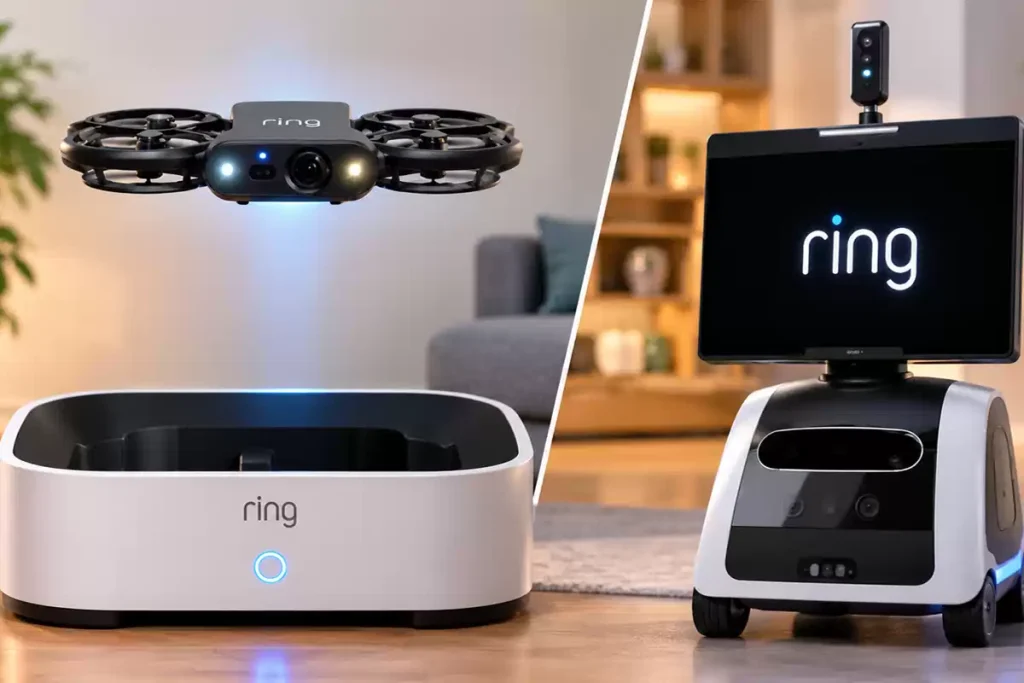
Ring has never been content with cameras that just sit there. On Tuesday, Amazon’s Ring Robotics division announced two new devices that move: a flying camera for the home and a rolling patrol robot for businesses.
The Two Machines
The Ring Drone Cam costs $249.99 and is an indoor camera that flies from room to room. Amazon expects to start shipping it in the U.S. on Jan. 27, 2027, though that date depends on FCC authorization.
The Ring Rover Cam is the bigger, pricier sibling at $999.99. It’s a security robot built to patrol business premises on its own and check out disturbances. Preorders are open, and shipping is slated to begin in the U.S. on Dec. 16.
Both run on something Ring calls AI Pilot, a custom system that maps a space, suggests patrol points and steers around obstacles. Ring’s founder and chief inventor, Jamie Siminoff, said customers have long asked for eyes in places a fixed camera can’t reach, along with peace of mind in spots where they’d never want one installed. The answer, he said, wasn’t simply more cameras. It required rethinking what a security device could be. He called this the start of a future where proactive, autonomous protection is available to every home and business.
A Guard Who Never Clocks Out
The Drone Cam is built around AI from the start. It has a 148-degree field of view and rotates a full 360 degrees, so it can take in an entire room in 2K video. Two built-in LED lights switch on automatically for low-light footage.
You can launch it yourself, but it can also act on its own. If a Ring camera, sensor or alarm is triggered, the drone flies to preset patrol points without being asked.
The Rover works differently. You can send it to any room or patrol point in a business, and once it arrives it does a 360-degree scan. It has a periscope camera that lets it peer over counters and shelving, plus a siren and a light tower that signal an area is being watched. It also supports two-way audio, and it records continuously in up to 4K for the whole patrol, including the stretches between stops.
One catch: scheduling drone flights or Rover patrols requires a compatible Ring Protect plan.
Amazon’s own pitch is that it’s like having a guard on patrol who never clocks out.
Raccoon or Robber?
The appeal of a camera that moves is easy to grasp. Anna Redmond, founder and CEO of physical security and risk advisory firm Braav, put it simply: a fixed camera waits for trouble to walk past, while a mobile one goes to the trouble. That closes blind spots without needing a camera in every room.
She also pointed to a very practical benefit. A raccoon or a fallen picture frame can trip an alarm, bring police to your door and, in many cities, earn you a false-alarm fine. Being able to send a camera to look first saves both money and time.
Redmond sees a safety upside too. Everyone knows the image of someone creeping downstairs at two in the morning clutching a baseball bat. In her view, a drone that checks first, asks the person to identify themselves, or tells you where the intruder is so you can get your kids out the back door means fewer tragedies. The most valuable thing a drone can buy you, she said, is reaction time.
Rebecca Edwards, a former head of editorial at home security review site SafeWise, framed it around peace of mind. Imagine your motion sensor goes off at 2 a.m. while you’re traveling. The drone can go look and show you whether it’s a burglar or the cat knocking over a plant. Much of security anxiety, she said, comes from not knowing, and devices like this reduce that. They can also do the work of several cameras and motion sensors, which saves money.
SafeHome managing editor Rob Gabriele made the same point about cost. Protecting every room today usually means buying a camera for every room and hallway, and that adds up fast. A drone flying a set path through the house could save a homeowner hundreds of dollars while adding a bit of extra reassurance.
A House That Actually Responds
Paul Biava, president of smart-home company ETC Florida, thinks the Drone Cam will introduce many people to an idea that has existed in high-end homes for years: a house that doesn’t just record what happened but reacts to it.
Most people, he said, still picture home security as a camera on the porch and an alarm on the wall. A drone that flies off to check a noise makes something click, because it shows that a home can do something when there’s a problem. Integrated homes have been locking doors, switching on lights and sending alerts on their own for a long time. What Ring has done is attach that idea to a device that can head straight to the spot where the alert came from, and that’s likely to make a lot more people curious about what else is possible.
Biava’s philosophy is that the best smart home doesn’t need to show off. It just reacts the way you would if you were standing there. He called the drone a pretty literal version of that idea and hopes it gets people thinking about what their whole home could do for them.
What It Means for the Security Industry
Justin Clarke, owner and president of video surveillance provider A2Z Security Cameras, sees this as a milestone. Cameras are shifting from stationary watchers to mobile or autonomous systems that can physically move, either on their own or under remote control. That’s been happening in commercial and industrial settings for years, he noted, and it’s now arriving in homes.
The timing matters, according to Daniel Holcomb, a senior analyst for smart home research at Parks Associates. The security market grew more slowly in the years leading up to 2026, and traditional providers spent that time trying to hold onto customers, pull them away from rivals and earn more from each one. Video devices both challenged those providers and opened new growth outside traditional intrusion systems built on door and window sensors.
But there’s a problem. Video devices are becoming commodities, and average prices are cratering. Holcomb believes new form factors, such as robotics-driven cameras, could breathe fresh life into the category. He described smart video devices as both an entry point to full security systems and an alternative to them, and said security is increasingly video-first, software-driven and proactive.
Parks data backs up the shift. Among current security system owners, 27% owned a camera or video doorbell before buying their system, and 39% use video devices that aren’t integrated with their system. More than a third of smart video device owners who don’t have a security system say they used to have one and now rely only on cameras or video doorbells.
Holcomb’s takeaway is that the way people think about security is changing. The companies that succeed, he predicts, will be the ones that blend video, AI, sensors and human response into a protection experience people can count on.