

Amazon’s new rapid-delivery service, Amazon Now, is officially being tested. Early trials suggest it not only meets the company’s 30-minute delivery promise but exceeds it comfortably.
In an independent evaluation on Tuesday, the ultra-fast delivery system completed a full order-to-doorstep cycle in just 23 minutes. This marks one of the fastest verified grocery delivery times by a major retailer.
The service is launching in select neighborhoods in Seattle and Philadelphia. Amazon positions it as a mix of a convenience store, a micro-fulfillment hub, and an instant-delivery platform designed for modern households.
A New Class of Hyperlocal Delivery
Amazon Now changes how the company manages last-mile logistics. Unlike traditional Amazon Fresh or Whole Foods orders, which depend on larger fulfillment centers and scheduled delivery times, Amazon Now works as a rapid-pick, rapid-ship system focused on speed.
Customers can browse a selected list of:
- Fresh fruit and vegetables
- Meat and seafood
- Pantry staples
- Refrigerated and frozen items
- Household supplies
- Basic everyday essentials
The catalog focuses on high-demand items, aligning more with convenience-store shopping than full grocery purchases.
Prime members pay lower delivery fees starting at $3.99, while non-Prime customers pay $13.99 per order. Orders under $15 incur an additional $1.99 small-basket fee, indicating that Amazon encourages smaller orders and quick delivery.
How Amazon’s 23-Minute Delivery Worked
The order was placed at 12:38 p.m., and the app immediately estimated a delivery window of 1:05 p.m. Both the app and confirmation email showed a clear status bar indicating each stage:
- Ordered
- Packed
- Out for delivery
- Delivered
Within minutes, the app moved from “ordered” to “out for delivery,” and the animated vehicle icon started its route across the city. At one point, the estimated arrival time improved to 1:02 p.m., showing that the driver had picked up the items.
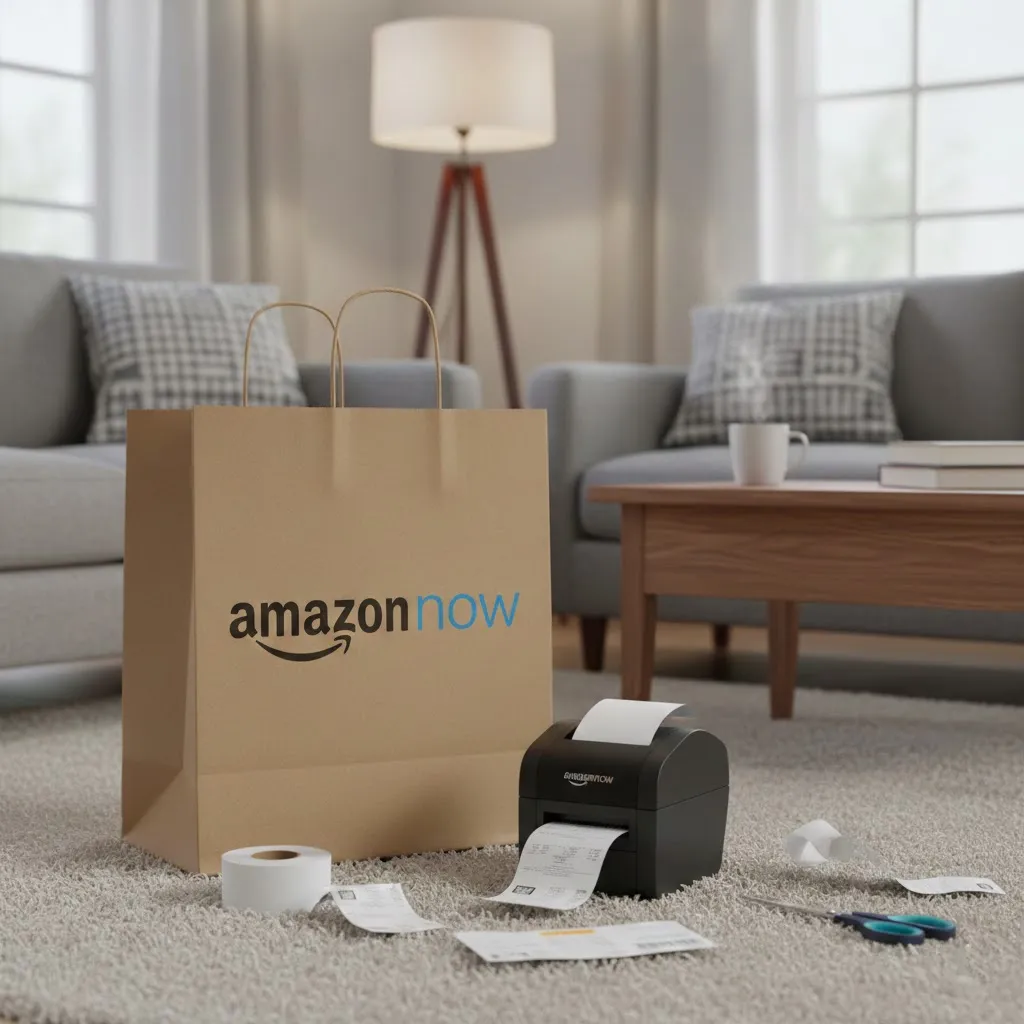
As the delivery vehicle icon got closer, a van pulled up, but it turned out to be a neighbor receiving a large furniture order. The Amazon driver arrived right on time, at 1:00 p.m., and handed over a brown Amazon Now paper bag with six neatly packed items.
Total time elapsed: 23 minutes.
Inside the Rapid-Delivery System
Behind the scenes, Amazon Now relies on a new model based on micro-hubs. These are small facilities located in neighborhoods rather than large warehouses.
Permit records and staffing documents reveal how the system operates:
1. Back-of-House Stockroom
Employees pick and bag items directly from a compact inventory stocked with high-demand goods.
2. Front-of-House Staging Shelves
Prepared bags are placed on organized shelves near the exit, ready for drivers to grab.
3. Amazon Flex Drivers
Independent contractors using the Amazon Flex system arrive, scan the order, confirm pickup, and leave within two minutes.
These hubs function 24 hours a day, 7 days a week, similar to convenience stores where inventory is constantly in motion.
One driver on Tuesday said his pickup happened at a neighborhood facility near a major grocery store in Seattle’s Roosevelt district, about 3.5 miles (15 minutes) from the delivery address. He mentioned he had not heard about another Amazon Now hub planned several miles away, suggesting multiple hubs may soon spread throughout the city.
Amazon Quietly Expands Its Micro-Fulfillment Network
Recent development filings show Amazon is increasing its number of rapid-delivery sites, with one project converting an old grocery pickup location into a full-scale Amazon Now hub.
These new facilities focus on:
- Frequent restocking
- Temperature-controlled storage
- Continuous item picking
- Fast driver turnover
- Round-the-clock operations
These centers emphasize small-item shopping occasions, such as:
- Forgetting an ingredient for dinner
- Running out of batteries
- Needing medicine or snacks urgently
- Being too sick to leave the house
This approach resembles convenience-focused delivery apps but leverages Amazon’s extensive logistics and data systems.
The Customer Experience: Fast, Efficient, and Mostly Seamless
Despite the speed, the items in the delivered bag arrived in good condition:
- The frozen pizza was still cold.
- The hummus was at a safe temperature.
- The produce, such as blackberries, looked fresh.
Only the loaf of bread was slightly squished, a common issue with grocery deliveries.
The order included six items, but only one-a pack of AA batteries-was necessary at that moment. The selection available through Amazon Now featured only small pack sizes, indicating Amazon’s focus on quick convenience rather than bulk shopping.
The quality of items, temperature control, and packing accuracy all met expected standards.
Impact on Urban Traffic and Last-Mile Logistics
Local transportation experts suggest that rapid-delivery networks like Amazon Now could significantly alter traffic patterns in major cities. Traditional grocery delivery systems create vehicle volume in certain areas and times, especially evenings and weekends.
Micro-deliveries could spread demand throughout the day, easing bottlenecks near larger fulfillment centers.
Early data in major metropolitan areas shows:
- Last-mile congestion is increasing
- Delivery vehicles are adding to roadway traffic
- Shorter, more frequent trips for commercial vehicles are becoming normal
An expert noted that services like Amazon Now could help balance out distribution by spreading deliveries through a wider network of micro-hubs.
Whether this decreases or increases urban congestion remains to be seen, but Amazon is betting that smaller, localized hubs will streamline routes, shorten drive distances, and improve driver efficiency.
Recreating the Convenience Store for the Digital Age
Amazon’s move into instant delivery comes at a time when shopping habits are shifting toward on-demand consumption. Convenience stores, once the go-to option for quick purchases, are facing competition from mobile delivery services that can deliver items faster than a customer can drive to the store.
Amazon Now effectively turns the company’s logistics into a virtual convenience store accessed through an app.
The operation mimics a store environment with:
- Constant stocking
- A focus on small, high-demand items
- 24/7 availability
- Quick service
Instead of customers walking the aisles, Amazon employees do the picking. Instead of customers driving home, Flex drivers handle the final leg.
A Consumer’s Perspective: Convenience vs. Habit
Not everyone is the target audience for rapid grocery delivery. Many people prefer browsing store aisles, interacting with staff, or selecting produce themselves.
The reviewer who completed the 23-minute test expressed:
- A preference for traditional grocery shopping
- A desire for in-person interaction
- No strong need for ultra-fast grocery delivery
Yet even those skeptical recognize the scenarios where Amazon Now excels:
When Amazon Now Makes Sense
- Feeling unwell and needing quick-relief items
- Missing a key ingredient for dinner
- Running low on essentials late at night
- Wanting to avoid traffic or long lines
- Needing something urgently without wanting to leave the house
For some households, especially younger users, Amazon Now may become their go-to method for buying everyday necessities.
As one teenager observing the test asked, “Is it like DoorDash?”
The comparison is valid, but Amazon Now’s main appeal lies in speed and reliability rather than food delivery.
Early Verdict: Amazon Now Redefines “Fast” in Grocery Delivery
Based on this initial evaluation, Amazon Now fulfills its promise: ultra-fast delivery that genuinely arrives in under 30 minutes.
Key strengths include:
- Consistent speed below the promised window
- Clear tracking in the app
- Reliable temperature control for perishable items
- Strong packaging quality
- Affordable pricing for Prime members
- A 24/7 operating model ready to expand
Minor drawbacks, such as limited item selection and smaller packages, are likely intentional—this service is for essential needs, not large grocery trips.
Conclusion: A Glimpse Into the Future of Everyday Shopping
Amazon Now represents a significant change in the competition for last-mile delivery. It combines:
- Micro-fulfillment
- Real-time order picking
- Local inventory
- Gig-economy delivery
- Continuous operations
The outcome is a service that could change customer expectations for speed, efficiency, and convenience.
For now, Amazon Now is only available in select neighborhoods. However, the company’s expansion and early performance indicate a clear path: instant grocery delivery may soon be as commonplace as same-day shipping.
Whether customers will widely adopt it will largely depend on their habits, lifestyles, and use cases. One thing is clear: Amazon Now has set a new standard for fast delivery in the modern retail space.