


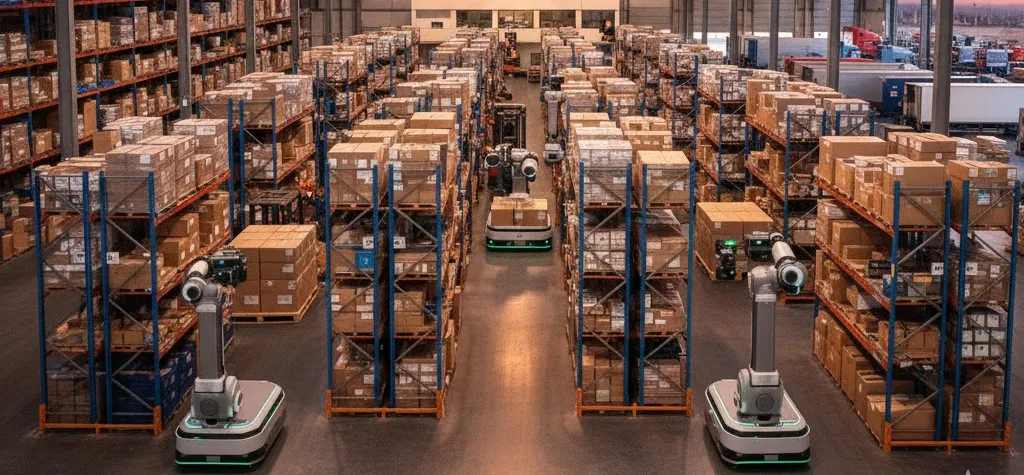
Inside a fast-growing robotics company betting that machines should handle the most punishing work – while humans focus on what they do best.
A Job the Human Body Was Never Designed to Do
Few jobs are as physically demanding or as quietly dangerous as unloading trucks in large warehouses. Day after day, workers lift, twist, stack, and move hundreds of boxes, many weighing up to 50 pounds. The work is repetitive and relentless, often performed under extreme conditions, from freezing winter docks to sweltering summer trailers where temperatures can exceed 120 degrees.
It’s no surprise that warehouse injury rates are more than double the national average. Employee turnover in logistics facilities also remains stubbornly high. The work takes a toll, both physically and mentally, causing many workers to leave within weeks or months.
A growing robotics company believes that burden should not fall on human bodies at all.
The Pickle Robot Company is building autonomous robots designed to take over one of the most grueling tasks in the supply chain: unloading trailers and shipping containers. Its machines lift heavy boxes, place them onto conveyor belts, and operate inside tight, unpredictable environments. This technology frees human workers from the most punishing parts of the job.
The company says it is not replacing people. Instead, its goal is to let humans step away from drudgery and focus on work that requires judgment, coordination, and problem-solving.
A Name That Signals Big Ambitions
The company’s playful name is intentional. The founders chose it as a nod to an early Silicon Valley icon, signaling their aim to become a leading technology company in supply chain automation.
Founded by engineers AJ Meyer, Ariana Eisenstein, and Dan Paluska, the company grew out of years of hands-on experience building complex systems. All three founders have backgrounds in computer science, electrical engineering, and robotics, and they had crossed paths through earlier work before teaming up.
Their ambition was not just to build a clever robot but to create a platform company that could shape how automation spreads across warehouses, factories, and logistics hubs.
From Consulting to Robots
Before starting the company, Meyer and Eisenstein worked for years in a technology consultancy that focused on embedded systems for demanding applications. Their work included robotics, vehicles, and aerospace systems, and they collaborated with major technology firms and government agencies.
Although the consulting business was successful, it wasn’t why they became engineers in the first place.
Over time, the founders felt that consulting, while intellectually rewarding, kept them from building products that could change industries. They wanted to create machines that would be used in the real world, not just prototypes or one-off systems but scalable technology.
By the late 2010s, the technical landscape had changed. Advances in machine learning, perception, and robotics control began to unlock capabilities that once seemed unattainable. Problems like navigation, object recognition, and manipulation were no longer purely academic.
The question was not whether robots could do more but where they should start.
Searching for the Right Problem
Rather than starting with a predetermined application, the founders searched for a genuine need.
They spoke with workers and managers across various industries—agriculture, food preparation, hospitality, manufacturing—to see where automation could make the biggest difference. They visited facilities, observed workflows, and timed how long it took people to complete various tasks.
Eventually, their search led them to logistics warehouses.
What they found was striking. In one facility, dozens of workers labored through overnight shifts unloading trucks by hand. Turnover was extreme. Many employees lasted less than three months.
When they asked why, the answer was blunt: the job was brutal.
That moment clarified the opportunity. If robots were ever going to help people at scale, this was the kind of work they should tackle first.
The Human-Robot Divide
The founders were careful not to frame the problem as humans versus machines.
Humans excel at handling unexpected situations, adapting to changes, and coordinating with others. Robots, on the other hand, are unmatched when it comes to repetitive, high-force tasks that require consistency rather than creativity.
Unloading trucks falls squarely into the second category.
Boxes vary in size and shape. Trailers shift. Lighting conditions change. Yet the underlying task remains the same: lift, move, repeat. It’s a perfect candidate for automation if the technology can handle enough variability.
The company’s approach is to let robots do what they’re best at while allowing humans to take roles that require flexibility and judgment.
Early Missteps and a Narrow Escape
Like many robotics startups, the company did not get everything right the first time.
Its initial products focused on sorting boxes, a technically simpler challenge that allowed the team to experiment with grippers, scanners, and perception systems. The robots worked, but customer demand was limited, growth was slow, and funding became harder to secure.
As capital ran low, the founders faced a difficult decision: continue refining an incremental product or attempt something far more ambitious.
They chose ambition.
With limited resources, the team built a rough prototype capable of unloading trucks for short bursts. It wasn’t polished, but it worked long enough to prove the concept. A short video posted online drew an unexpected response. Hundreds of companies reached out, eager to explore the technology.
This surge of interest brought investors back to the table and gave the company a second chance.
From Prototype to Production
The first real-world pilot took place in challenging conditions. In the California desert, robots unloaded shipping containers where interior temperatures could rise to dangerous levels. For human workers, these conditions were exhausting and risky. For machines, they were just another variable to manage.
The pilot ran for a year, improving reliability and performance. From there, deployments expanded across the country, including partnerships with major logistics providers and manufacturers.
Today, the company’s robots work alongside human teams in warehouses, quietly handling some of the most physically demanding tasks.
How the Robots Work
At the heart of each system is an industrial robotic arm adapted from equipment commonly used in manufacturing. Mounted on a custom mobile base, the robot can navigate to loading docks and reposition itself inside trailers on its own.
Key features include:
- A suction-based gripper capable of lifting various box sizes
- Cameras and sensors that map unfamiliar environments upon arrival
- Machine-vision systems that identify packages in cluttered spaces
- Onboard computing that allows real-time decision-making
The robots handle boxes ranging from small parcels to large, heavy cases, unloading hundreds—and in some cases more than a thousand—items per hour.
Instead of relying on a single AI model, the system uses a mix of pre-trained generative models and specialized algorithms tailored for specific tasks. This layered approach allows the robot to remain reliable across different warehouses, lighting conditions, and package types.
A Platform, Not Just a Robot
While unloading is the company’s main application, the founders see it as just the beginning.
Behind the hardware is a growing software platform designed to connect with other autonomous systems—from forklifts to palletizing robots to inventory drones. They envision a coordinated network of machines that can communicate, share context, and optimize workflows across the supply chain.
In this future, automation will not be a collection of isolated tools but an integrated system that spans everything from raw materials to final delivery.
Inside the Company
The company employs over 100 people, with headquarters that combine traditional office space with an active warehouse floor. Engineers, operators, and robots work side by side, testing new systems and refining deployments.
Production is ramping up, with plans to introduce new hardware designs and eventually develop robots with additional capabilities, including dual-arm systems.
The culture emphasizes humility and collaboration. Robotics is difficult, the founders note. Success relies on teams with diverse expertise and a willingness to learn quickly.
Why This Moment Matters
Warehouse automation has been promised for decades, but progress has often fallen short of expectations. Proponents argue that the difference now is maturity—in sensors, computation, and machine learning—combined with economic pressures from labor shortages and injury rates.
For workers, robots that handle the heaviest lifting could mean fewer injuries, longer careers, and more stable roles. For employers, reducing turnover and increasing productivity offer clear incentives.
The company’s founders do not claim to have solved automation entirely. Instead, they see unloading as the first chapter in a much longer story.
Their broader goal is to build a foundation—technical, operational, and organizational—that allows robots to take on more of the work humans were never meant to do.
In doing so, they hope to reshape how the supply chain functions, one heavy box at a time.