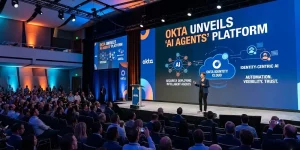



Okta has announced a new security framework aimed at helping organizations manage the growing risks associated with AI agents. The blueprint for a “secure agentic enterprise” is designed to address how businesses can track, control, and govern autonomous AI systems operating across their environments.
To support this approach, Okta also introduced Okta for AI Agents, a platform built to discover, manage, and secure both known and unknown AI agents while enforcing enterprise-grade identity controls.
Addressing Rapid Growth of Autonomous AI Agents
AI agents are evolving quickly, gaining the ability to execute complex workflows, access enterprise systems, and operate with minimal human oversight. These systems can perform tasks such as running commands, interacting with applications, transferring data, and maintaining persistent memory.
Tools like OpenClaw highlight how advanced these systems have become, with capabilities to operate directly on user machines and coordinate multiple sub-agents for specialized tasks.
Okta noted that traditional security frameworks are struggling to keep pace with this level of autonomy. As a result, organizations need new approaches to monitor agent behavior and mitigate risks associated with compromised or rogue AI systems.
Core Framework: Three Key Questions
Okta’s blueprint is structured around three fundamental questions enterprises must answer:
- Where are AI agents operating?
- What systems and resources can they access?
- What actions are they allowed to perform?
By focusing on these areas, the framework aims to bring visibility and control to increasingly complex AI-driven environments.
Discovering and Managing AI Agents
A central component of Okta’s platform is the ability to identify and manage all AI agents within an organization. This includes both approved systems and “shadow agents” created without IT oversight.
The platform enables enterprises to:
- Detect unsanctioned AI agents connected to enterprise applications
- Register agents as first-class, non-human identities
- Assign human ownership and accountability for each agent
Okta is also expanding its integration network, which includes more than 8,000 applications, to support AI agent platforms such as Boomi, DataRobot, and Google Vertex AI.
Centralized Control and Access Governance
To regulate how AI agents interact with enterprise systems, Okta has introduced several control mechanisms.
Agent Gateway
The Agent Gateway acts as a centralized control layer that governs how AI agents access tools, APIs, applications, and databases. It also logs all interactions for auditing and monitoring purposes.
Privileged Credential Management
The platform includes secure credential vaulting and automatic rotation to prevent sensitive data exposure. This ensures that credentials are not stored in plain text while maintaining a full audit trail.
API Access Management
Okta enforces least-privilege access by dynamically evaluating identity, context, and risk before granting permissions. This helps prevent unauthorized access and limits lateral movement within systems.
Identity and Lifecycle Management
Okta is extending its Universal Directory to treat AI agents as full-fledged identities within enterprise systems. This enables organizations to manage the entire lifecycle of an AI agent—from onboarding to decommissioning.
By integrating AI agents into standard identity governance processes, businesses can apply consistent policies, conduct access reviews, and maintain visibility into agent activity.
Security Controls and Risk Mitigation
As AI agents gain autonomy, real-time security controls become critical. Okta’s platform introduces several features to address these risks.
Universal Logout (Kill Switch)
A key capability is the ability to instantly revoke an agent’s access across all systems. If suspicious behavior is detected, organizations can deactivate the agent’s permissions in real time to contain potential threats.
Governance and Access Reviews
AI agents can be incorporated into existing governance workflows, enabling automated reviews, policy enforcement, and assignment of human accountability.
Logging and Monitoring
The platform provides detailed system logs that track agent activity, including tool usage, access attempts, and authorization decisions. These logs can be integrated with SIEM systems to support real-time monitoring and incident response.
Industry Collaboration and Ecosystem Integration
Okta emphasized the need for collaboration across the industry to address the challenges of securing AI agents. Partnerships with platforms like Boomi and DataRobot aim to combine integration capabilities with identity-driven security controls.
This ecosystem approach is intended to help organizations adopt AI technologies while maintaining strong governance and compliance standards.
Outlook: Securing the Agentic Enterprise
The introduction of Okta’s blueprint reflects a broader shift in enterprise security as AI agents move from experimental tools to operational systems. As organizations deploy more autonomous agents, the need for robust identity, access control, and monitoring frameworks continues to grow.
By positioning AI agents as managed identities and providing centralized control mechanisms, Okta aims to establish a foundation for secure adoption of agentic AI across industries.
The company’s approach signals a growing recognition that security will play a defining role in how quickly and safely enterprises scale AI-driven operations.