

Generative AI is starting to change the entertainment industry in ways that match the impacts of sound, color, and computer graphics. After two weeks of using OpenAI’s latest video generation system, Sora, it’s clear that the transformation happening now is not small. It is significant, unpredictable, and moving faster than many in Hollywood are ready to accept.
The technology has already sparked mixed reactions among creators, studio heads, and policy experts. Many feel excited about its creative potential, while others are worried about the ethical, economic, and cultural disruptions it could cause. As AI-generated video evolves from short, experimental clips to longer, fully coherent scenes, the industry faces a complete redefinition of how movies and television are planned, funded, made, and watched.
This is the new Hollywood, and generative AI is set to become its most disruptive force yet.
A Glimpse Into the Future: Worlds Generated From Words
Creating video with Sora is surprisingly easy. With just a text prompt, the system creates realistic, cinematic sequences that once needed full crews, actors, lighting specialists, set designers, and costly post-production teams.
A simple prompt like,
“Me at Yankee Stadium hitting a World Series Game 7 walk-off home run,”
yields a scene that looks authentic—right down to the stadium lighting, crowd reactions, and camera movements.
This democratization of visual creation has surprised early users. In minutes, Sora turns imagination into moving images, skipping almost every production barrier that has defined filmmaking for a hundred years.
But this awe coexists with a strong, immediate anxiety.
The Dark Side: Deepfakes, Likeness Theft, and AI-Enabled Misinformation
While generative video tools open up new creative paths, they also create serious risks. Researchers have shown that advanced AI systems can make highly convincing fake videos that could be used for:
- Political manipulation
- Financial scams
- Revenge deepfakes
- Character defamation
- Synthetic celebrity and influencer impersonation
One expert recently described the growing threat as “an industrial-scale misinformation pipeline,” where manipulated videos can seem real to those who don’t know better, rapidly spreading on social media.
Even more troubling are instances of “likeness theft,” where people’s faces and identities appear in synthetic videos without permission. In one well-known case, a meteorologist found her image being misused in fraudulent deepfake content targeting her followers.
These dangers highlight the urgent ethical challenges surrounding generative video technology. Beyond this, there is a larger structural change that Hollywood has barely begun to tackle.
- From Smartphones to Sora: The Next Wave of Creative Disruption
The entertainment industry has already gone through one wave of democratization with the rise of high-quality smartphone video.
Over the last 15 years, advancements in smartphone cameras turned every user into a potential content creator. Features like:
- Real-time stabilization
- Automated color correction
- Computational depth-of-field
- High dynamic range
These once required pricey equipment and professional teams. With smartphones, they became instant and accessible to everyone.
Generative AI is the next big leap.
Smartphones made capturing reality easy. AI makes creating reality from scratch simple.
A detective walking down a rain-soaked alley no longer needs:
- A physical location
- Costumes
- Actors
- Lighting setups
- Permits
- Props
- Post-production effects
Now, only a text description is necessary.
Even “impossible shots”—like a drone flying through a skyscraper window into a teacup—can be created with no physical equipment at all.
This complete separation of visual storytelling from physical constraints makes generative AI fundamentally different from every previous tool.
Hollywood Economics on the Brink: The 50-Person Blockbuster
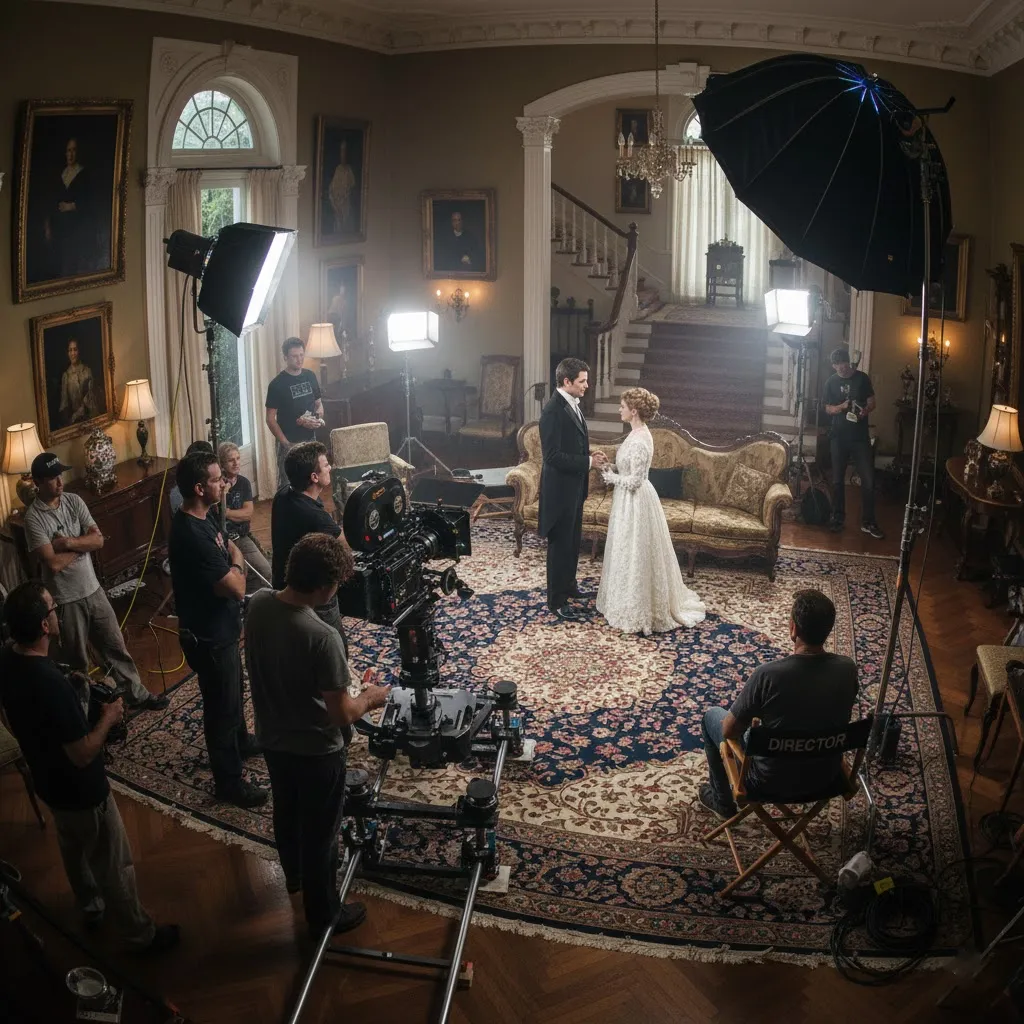
A typical Hollywood film involves 300 to 500 crew members across many specialized departments:
- Camera
- Lighting
- Makeup
- Costumes
- Sound
- Transportation
- Catering
- Props
- Set design
- Post-production
- VFX
Generative AI could disrupt this entire structure. In a production process enhanced by AI, a film that once required hundreds of workers may need fewer than 50.
This doesn’t mean creativity is any less important; rather, labor-intensive tasks such as location scouting, set building, lighting design, and some acting roles can be simulated or automated.
The long-term outcome? The financial barrier to filmmaking could drop drastically.
An independent filmmaker with a laptop might soon wield the visual power of a $200 million studio production. Instead of large studios serving as gatekeepers, the new limits could be imagination and directorial skill.
Hollywood has experienced disruption before. But it has never encountered a tool that replaces so many roles at once.
The Rise of the AI-VFX Director
Rather than eliminating the need for talent, generative AI raises the importance of creative vision.
The new creative role—part director, part cinematographer, part prompt engineer-must convey human emotion into detailed, technical language.
Future prompts will look like full cinematography instructions, such as:
“Close-up of a 60-year-old man with deep-set wrinkles. Lighting from a single flickering overhead fluorescent light. Use an 85mm lens, shallow depth of field, rack focus from his eyes to a wedding ring. Mood inspired by Edward Hopper paintings. Emulate Kodak Vision3 500T film grain.”
This isn’t casual prompting. It’s precise filmmaking through words.
The director becomes the primary creator, the sole source of artistic intent in a process where AI handles the technical tasks. Those who master this blend of skills may become the defining creators of the AI-generated film era.
Why AI Movies Aren’t Feature-Length Yet
If AI can create stunning short clips today, why not a full-length movie?
The answer is the cost of computing.
Producing a few seconds of photorealistic video with coherent physics requires significant processing power. Stretching that to a 2-hour film is currently too costly and slow for most creators.
But this limitation won’t last.
Companies like Nvidia, AMD, Intel, and Qualcomm are racing to design hardware specifically for generative video. As data center efficiency improves and the cost of GPU cycles declines, full-length AI films will go from impossible to likely.
The timeline is shortening quickly.
Labor Unions Prepare for Impact
Hollywood unions—especially SAG-AFTRA and the Writers Guild—have been expecting AI disruption for several years. Their worries fall into three main categories:
- Economic displacement, as AI lowers demand for certain roles
- Likeness protection, ensuring actors are paid for digital replicas
- Creative integrity, keeping human artistry intact
These concerns are not just speculation. Actors, voice artists, and background performers have already reported attempts by producers to secure lifelong digital rights.
The unions know that if AI-generated films go mainstream before new rules are established, performers could lose long-term negotiating power.
The First AI ‘Toy Story’ Will Change Everything
Industry observers believe that generative video won’t gain legitimacy until a breakthrough AI-created film achieves widespread success—similar to how Pixar’s Toy Story validated fully computer-animated films in 1995.
But what type of AI movie will audiences accept first?
A direct replacement for human actors would likely face backlash.
A more likely early success is AI-assisted restoration rather than replacement.
Imagine a new adaptation of a classic musical or play, but with AI digitally recreating performers from the original Broadway cast in their prime—giving audiences a version of the show that was never filmed.
This project would feel less threatening, more like cultural preservation than disruption.
Once an AI-produced film gains critical acclaim—perhaps even winning a major award—resistance will lessen. Acceptance will increase. The entire industry will change.
When an AI-generated movie wins Best Picture, the transformation will be undeniable.
The Road Ahead: Opportunities, Risks, and a Redefined Industry
Generative AI is not just another tech advancement. It rewrites:
- How stories are visualized
- How films are produced
- How talent is valued
- How intellectual property is defined
- How audiences experience entertainment
As tools improve and computing becomes more affordable, AI-created cinema will evolve from experimental clips to full-length, emotionally rich storytelling.
The transition will be challenging. Jobs will change. Ethical frameworks will be tested. New creative forms will emerge.
But one truth seems more certain:
The next era of Hollywood will not be built on cameras and physical sets, but on computation, creativity, and code.
And the revolution has already begun.