


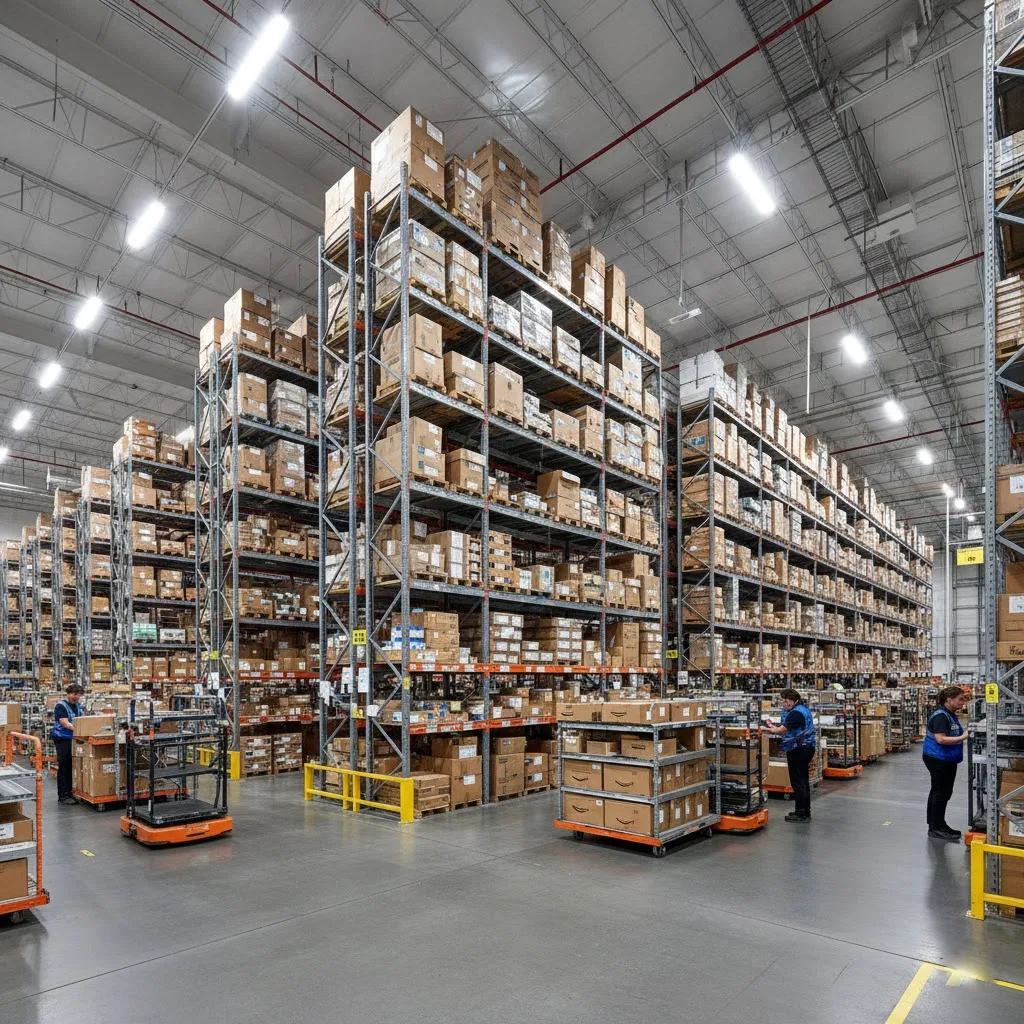
SUMNER, Wash. At first glance, the activity inside Amazon’s Packaging Innovation Lab looks like a test for cardboard rather than research on sustainability.
Boxes tumble from platforms of different heights. Others vibrate for hours, mimicking the continuous rumble of a delivery truck traveling long distances. Some are crushed under heavy loads that replicate the weight of stacked cargo in a warehouse or shipping container.
Nothing here is accidental.
Every drop, shake, and squeeze is part of Amazon’s effort to answer a simple question: Can the world’s largest e-commerce company safely deliver billions of packages without using plastic?
Amazon believes the answer is yes, but only if packaging is redesigned from scratch.
A Lab Built to Break Boxes on Purpose
Located south of Seattle, the Sumner facility is a key testing ground for next-generation packaging. Engineers, designers, and operations specialists work together, testing materials that can protect everything from fragile glass to bulky household items without plastic envelopes, air pillows, or synthetic padding.
The lab closely coordinates with a nearby fulfillment center, where robotic lines and automated bagging systems put new designs into real-world use.
“Our goal is to move toward all-paper packaging materials,” said John Sly, Amazon’s senior lab and field manager at the Sumner site. “But we must do this without sacrificing product protection or delivery speed.”
Striking a balance between sustainability and reliability is central to Amazon’s packaging challenge.
Why Amazon Is Betting on Paper
Plastic has long been a staple of e-commerce packaging. It’s lightweight, strong, water-resistant, and inexpensive. However, it comes with increasing environmental and reputational costs.
Amazon points out that paper has one major advantage: it can be easily recycled.
In many areas, customers can easily recycle paper bags, boxes, and filler materials. On the other hand, plastic film and cushioning often end up in landfills because they are hard to process through local recycling systems.
Amazon’s leadership believes that switching to paper-based solutions cuts down on waste and boosts the chances that packaging materials will be reused or recycled.
This belief is driving a company-wide push to remove plastic from shipping envelopes, cushioning, and secondary packaging.
Measurable Progress with Limits
Amazon is careful not to set a specific deadline for completely eliminating plastic packaging. A company spokesperson said that the goal is ongoing and that progress is reported annually.
Those reports indicate meaningful, though slow, change:
- Amazon reduced its use of single-use plastic delivery packaging by 16.4% globally in the most recent reporting year.
- In October 2024, the company stopped using inflated plastic air pillows worldwide, replacing them with crumpled recycled paper.
- By the end of 2024, over half of Amazon’s North American fulfillment centers had stopped using plastic shipping materials altogether.
- As a result, 37% of shipments in North America still had single-use plastic packaging in 2024, down from 65% the previous year.
These reductions came after years of pressure from environmental advocacy groups and some shareholders, as well as Amazon’s larger commitment to achieve net-zero carbon emissions.
Still, the company admits that packaging is just one piece of a much larger sustainability challenge.
Sustainability Gains vs. Carbon Reality
While Amazon’s packaging footprint has improved, its overall environmental impact tells a more complicated story.
The company reported a 6% rise in its total carbon footprint last year, largely due to the rapid growth of data centers and cloud infrastructure. At the same time, the demand for faster delivery including same-day and next-day shipping raises concerns that speed offsets progress made elsewhere.
Amazon responds that its dense network of fulfillment centers cuts transportation distances and that emissions per shipment have steadily declined since 2019.
It is also using electric delivery vans for last-mile shipping, though analysts observe that overall emissions in the sector continue to rise due to increasing e-commerce demand.
In this context, packaging is one of the more visible and solvable sustainability issues Amazon can address.
Automating the Move Away From Plastic
At the Sumner fulfillment center, the shift toward paper is linked with automation.
Instead of relying on workers to select box sizes or stuffing materials manually, Amazon is increasingly using machines that create custom-fit packaging as needed.
One system folds thin corrugated cardboard around individual products as they move along a conveyor belt. The material is lighter and more flexible than traditional shipping boxes, allowing it to fit closely to the item inside.
The result is a package that uses:
- Less material overall.
- No extra cushioning.
- Less space in delivery vehicles.
Another innovation repurposes machines originally made for manufacturing plastic mailers. Instead of replacing them, Amazon modified the equipment to work with paper.
This approach saves time and money since fulfillment centers are already set up for these machines. Engineers simply adjusted the systems to handle paper edges and seals instead of plastic.
The Human Side of the Machine
Even with heavy automation, people remain an important part of the process.
On a recent morning, process assistant Todd Grasser stood next to one of the paper-bagging machines, feeding in items ranging from probiotic supplements to children’s coloring books.
The machine can bag up to 500 items per hour, Grasser said. His personal best? Just below that.
“Personally, I do about 475,” he said with a smile.
Currently, these automated solutions work best for single-item shipments, like orders split across multiple fulfillment centers or purchases with just one product.
Multi-item orders, especially those with different shapes or levels of fragility, are still more challenging to package without plastic.
Rethinking the Box Altogether
One of Amazon’s most effective strategies is to eliminate unnecessary packaging entirely.
Instead of putting a boxed product inside a larger shipping box, Amazon is increasingly collaborating with manufacturers to ship items in their original packaging.
This approach, often called “ship in own container,” reduces material use and simplifies fulfillment.
In some cases, manufacturers have redesigned packaging for this purpose. For instance, select consumer goods arrive in plain brown boxes that can be turned inside out after delivery to showcase colorful branding or images.
This partnership model shifts some responsibility upstream, but also gives manufacturers more control over how their products are presented and protected.
Testing the Limits of Paper
Replacing plastic isn’t as simple as changing materials. Paper behaves differently under stress, moisture, and compression, so Amazon tests every scenario.
In the Sumner lab, engineers simulate:
- Drops from various heights.
- Long-duration vibrations.
- Extreme stacking pressure.
- Changes in temperature and humidity.
Each new design must protect the product inside while using minimal material and fitting smoothly into Amazon’s logistics system.
“It’s a balancing act,” Sly said. “We’re focusing on protection while reducing packaging, and we still have to meet the delivery speed customers expect.”
A solution that works perfectly in a lab might not hold up in a real-world delivery network that spans thousands of miles and millions of packages each day.
Why Speed Complicates Sustainability
Amazon’s promise of fast delivery adds another layer of complexity.
Tighter delivery windows leave less room for mistakes. Packages must endure rapid handling, automated sorting, and high-volume transport without delays due to damage or repacking.
“Paper solutions can be deployed quickly,” said Amazon spokesperson Saige Kolpack. “But we have to ensure they’re the right solution. There are implications across the entire network.”
A packaging change in one fulfillment center can affect transportation, storage, and delivery systems worldwide.
Pressure From Outside and Inside
Amazon’s packaging efforts have been influenced by both internal goals and external scrutiny.
Environmental groups have long criticized the company’s use of plastic, arguing that its size magnifies the impact of even small inefficiencies. Shareholders have also pushed for clearer timelines and accountability regarding waste reduction.
At the same time, Amazon employees in operations and sustainability teams have advocated for quicker adoption of alternatives while stressing the need to avoid unintended consequences like increased product damage or customer dissatisfaction.
The result is a careful but steady transformation rather than a sudden overnight change.
What Success Looks Like and What Comes Next
Amazon has not established a single endpoint for its plastic reduction efforts. Instead, executives describe the work as ongoing improvement-testing, learning, and refining at scale.
In the near term, the company expects to:
- Expand paper-based packaging automation to more fulfillment centers.
- Increase the percentage of items shipped in original packaging.
- Further cut single-use plastic where viable alternatives are available.
Longer term, the challenge will be to maintain these gains without increasing emissions elsewhere in the system-a task complicated by rising demand for faster shipping and growing cloud infrastructure.
A Massive Experiment in Real Time
Amazon’s packaging overhaul is not just a sustainability initiative; it’s one of the largest real-world experiments ever conducted in logistics, materials science, and automation.
Every redesigned box, every retrofitted machine, and every crushed test package represents a small step toward a new model of e-commerce-one that seeks to balance convenience with responsibility.
The stakes are high. With billions of packages shipped each year, even small improvements can have a significant impact.
Whether Amazon ultimately succeeds in completely eliminating plastic packaging remains uncertain. But in a lab in Sumner, Washington, cardboard boxes keep falling, shaking, and bending, quietly shaping the future of how goods move around the globe.