


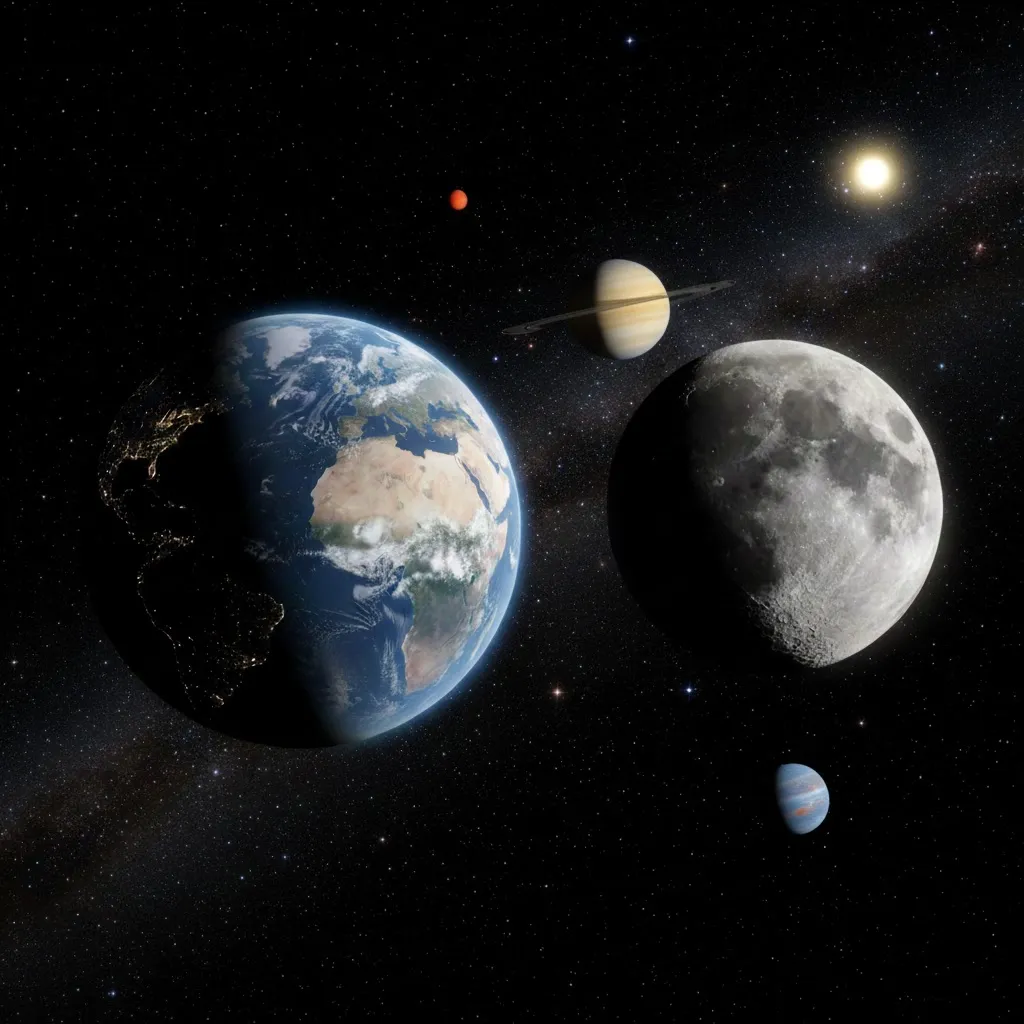
For decades, people have seen the Moon as a barren, lifeless place, filled with gray dust, sharp craters, and silence. Its surface, battered by radiation and micrometeorite impacts for billions of years, seemed to reveal little more than a history of cosmic violence.
However, new research is changing that view.
Recent findings suggest that the Moon may hold something much more Earth-like within its soil. It may carry traces of our planet’s atmosphere, delivered steadily over billions of years through an unexpected connection between the Sun and Earth’s magnetic field. These particles, which include water-related compounds and nitrogen, could one day help sustain human life on the lunar surface.
This is not science fiction. It arises from detailed models, decades-old lunar samples, and a new way of thinking about how planetary magnetic fields interact with space.
A Long Journey From Earth to the Moon
The concept that Earth and the Moon exchange material is not new. Scientists have known for a long time that meteor impacts on the Moon can send debris that eventually lands on Earth. What is new is the understanding that Earth has also been sending material to the Moon, not in rocks, but as invisible streams of atmospheric particles.
According to recent research, tiny charged particles from Earth’s upper atmosphere have been escaping into space and reaching the Moon for billions of years. Instead of being blocked by Earth’s magnetic field, as once thought, these particles may have been directed by it.
This process challenges long-held beliefs about how planetary magnetic shields operate.
Rethinking Earth’s Magnetic Shield
Earth’s magnetic field is often seen as a protective bubble. It deflects harmful solar radiation, keeps the atmosphere from being stripped away, and helps maintain conditions suitable for life. For years, scientists believed this magnetic barrier would also stop atmospheric particles from escaping into space.
New research suggests that this isn’t always the case.
Rather than acting as a sealed dome, Earth’s magnetic field can work like a funnel. When solar wind, a constant flow of charged particles from the Sun, hits Earth’s upper atmosphere, it can free atoms and molecules. These particles then travel along magnetic field lines that extend far into space.
Some of those lines reach all the way to the Moon.
Over vast timescales, this connection may have allowed small amounts of Earth’s atmosphere to build up in lunar soil.
Clues Hidden in Apollo-Era Moon Dust
The story starts with samples collected over 50 years ago.
During the Apollo missions in the late 1960s and early 1970s, astronauts returned with hundreds of kilograms of lunar soil, known as regolith. Scientists have studied these samples for years to learn about the Moon’s geological history.
What they discovered was unexpected.
Lunar regolith contains volatile elements-substances that easily evaporate-including:
- Water-related compounds
- Carbon dioxide
- Helium
- Argon
- Nitrogen
Some of these elements were expected. The solar wind bombards the Moon and implants particles into its surface. But certain measurements were surprising, especially the amount of nitrogen.
The levels were too high to be explained by solar wind alone.
This discrepancy suggested another source.
An Old Hypothesis, Revisited
In the early 2000s, researchers proposed that some volatiles in lunar soil might have come from Earth’s atmosphere. Their bold idea had one major limitation: they believed this transfer could only have happened very early in Earth’s history, before the planet developed a strong magnetic field.
Once Earth’s magnetic shield formed, they thought atmospheric escape would stop.
The new research challenges that assumption.
Modeling Billions of Years of Atmospheric Escape
To investigate how Earth’s atmosphere could have reached the Moon, researchers used advanced computer simulations to model interactions among solar wind, Earth’s atmosphere, and the planet’s magnetic field.
They explored two scenarios:
- 1. An early Earth with little or no magnetic field and strong solar wind
- 2. A modern Earth with a strong magnetic field and weaker solar wind
The expectation was that the early Earth scenario would allow more atmospheric loss. Instead, the simulations revealed something surprising.
The modern Earth scenario was much more effective at transmitting particles to the Moon.
In this model, Earth’s magnetic field did not block escape; it guided it.
Charged particles, once freed from the upper atmosphere, followed magnetic field lines into space. Some of those lines connected directly to the Moon’s orbit, allowing particles to land on its surface.
This process didn’t require dramatic events or rare conditions. It occurred slowly and steadily, over billions of years.
A Chemical Archive Written in Moon Dust
The implications are significant.
If Earth’s atmosphere has been depositing material on the Moon for billions of years, then lunar soil may hold a long-term record of Earth’s atmospheric changes. Unlike Earth, which continually recycles its surface through tectonics, erosion, and weather patterns, the Moon preserves history with remarkable detail.
This makes lunar regolith a potential archive of:
- Earth’s ancient atmosphere
- Changes in climate and atmospheric composition
- The evolution of Earth’s magnetic field
- Conditions that influenced the rise of life
By studying lunar soil layers, scientists might reconstruct snapshots of Earth’s past that would otherwise be lost.
From Scientific Curiosity to Human Survival
Beyond its historical significance, finding Earth-derived volatiles on the Moon could have practical implications for future human space exploration.
Water and nitrogen are vital for life. Nitrogen is essential for breathable air and fertilizers. Water supports drinking, agriculture, and fuel production.
If lunar soil contains more of these resources than previously believed, it could lessen the need to send supplies from Earth-one of the biggest logistical and financial hurdles of long-term lunar missions.
Future astronauts could potentially extract and reuse local materials instead of relying entirely on Earth.
Why This Matters for Permanent Lunar Bases
Both space agencies and private companies are planning for a long-term human presence on the Moon. These plans depend on a concept called “in-situ resource utilization,” which uses local materials to support life and operations.
The discovery that lunar soil may contain Earth-derived volatiles strengthens this idea.
It suggests that the Moon is not just a desolate outpost, but a place that has quietly gathered life-supporting elements over geological time.
While the concentrations are low and extraction remains technically difficult, the underlying principle is powerful: the Moon may already have some of what humans need to survive there.
Lessons for Other Worlds
The research extends beyond the Moon.
By understanding how Earth’s atmosphere escaped along magnetic field lines, scientists gain insights into how other planets evolve-especially those that have lost their atmospheres.
Mars, for instance, lacks a global magnetic field today. Yet there is evidence suggesting it once had one, complete with a thicker atmosphere and flowing water.
Studying how Earth’s atmosphere interacted with its magnetic field over different periods could help explain why Mars became barren while Earth remains habitable.
These insights also aid in the search for habitable exoplanets. Magnetic fields, atmospheric retention, and solar wind interactions are crucial in determining if a planet can support life.
A Subtle Process With Outsized Impact
One of the most striking aspects of this research is how subtle the process is.
There were no dramatic explosions or sudden atmospheric losses. Instead, Earth has been gradually releasing tiny amounts of its air into space, guided by magnetic forces and solar interactions.
On their own, the particles are insignificant. Over billions of years, they accumulate.
This slow exchange between Earth and the Moon emphasizes the interconnectedness of planetary systems and reminds us that space is not empty, but dynamic and interactive.
The Moon as a Living Record
For generations, the Moon was seen simply as a static relic, frozen in time. Now, scientists are starting to see it as an active part of Earth’s history-a silent witness to our planet’s atmospheric changes.
Each piece of lunar soil may hold clues about Earth’s past and resources for humanity’s future beyond this planet.
As researchers continue to study Apollo samples and plan new lunar missions, the Moon’s value is growing beyond exploration and symbolism. It is becoming a lab, an archive, and perhaps, a partner in supporting human life off the planet.
What once seemed like dust may prove to be one of our most valuable resources-not just for understanding where we’re going, but for remembering where we came from.