


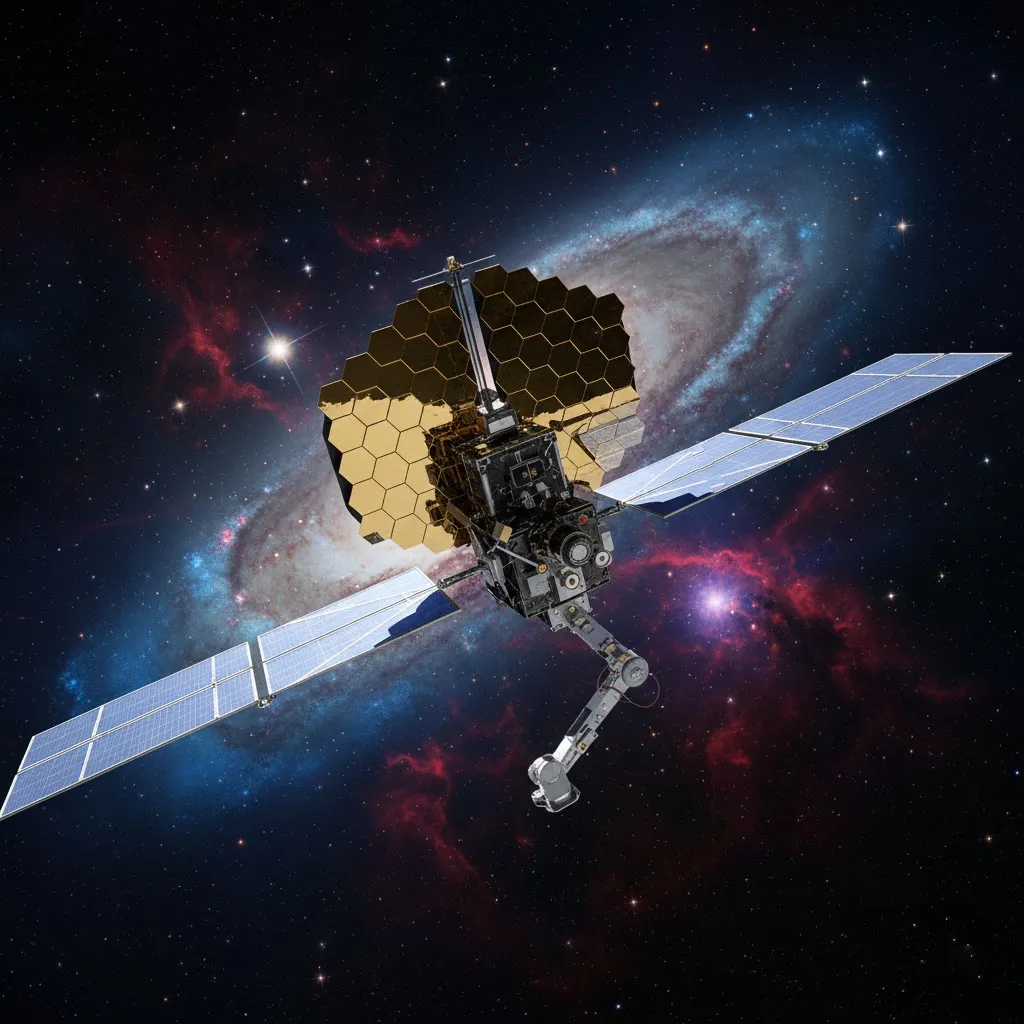
Eric Schmidt, former CEO of Google, and his wife, philanthropist Wendy Schmidt, are making a big investment in the future of astronomy. Through their private initiative, they are funding four advanced telescopes: one in space and three on Earth. These telescopes aim to greatly enhance humanity’s ability to observe and understand the universe.
The centerpiece of this effort is Lazuli, a space observatory meant to outdo the aging Hubble Space Telescope. Unlike many recent private space ventures, the Schmidts are not selling access to these instruments or their data. Instead, all observations will be freely shared with the global scientific community.
This initiative, called the Schmidt Observatory System, is one of the largest private investments in astronomy in recent history. While the exact amounts are not disclosed, sources indicate that total spending is likely to exceed half a billion dollars. This approach revives an older model of scientific funding that existed before government-dominated space exploration.
Reviving a Pre-War Model of Scientific Patronage
Before World War II, private benefactors shaped much of astronomy. Wealthy individuals and foundations funded major observatories, allowing scientists to pursue ambitious projects without facing many bureaucratic barriers. Over time, as telescopes became larger and more costly-especially after spaceflight began-governments and universities took over funding.
The Schmidts are now reversing that trend.
“For 20 years, Eric and I have pursued philanthropy to seek new frontiers, whether in the deep sea or in the profound connections that link people and our planet,” said Wendy Schmidt in a statement. “With the Schmidt Observatory System, we’re enabling multiple approaches to understanding the vast universe where we are stewards of a living planet.”
Instead of waiting decades for approval from national space agencies, the Schmidts are directly funding ideas that scientists have already proposed but could not realize due to a lack of funds.
Lazuli: A Modern Successor to Hubble
The most ambitious project is Lazuli, an optical space telescope named after the deep-blue gemstone lapis lazuli. It is set to launch in late 2028 and begin scientific operations in 2029.
With a 3.1-meter primary mirror, Lazuli will match and in some ways exceed Hubble’s capabilities. Its unique feature is its orbit.
Rather than circling Earth at about 500 kilometers, Lazuli will take a highly elliptical path. At its closest, it will be around 77,000 kilometers from Earth-twice as high as geostationary satellites-stretching to 275,000 kilometers at its farthest point.
This orbit offers two key benefits. First, it keeps Lazuli out of the crowded low-Earth orbit, where satellite constellations can interfere with observations. Second, it enables constant communication with ground stations, allowing quicker data transmission and more responsive observations.
“We have decades of technological advancements since Hubble,” said Arpita Roy, head of the Astrophysics & Space Institute at Schmidt Sciences. “Lazuli is a modern version of Hubble, with a larger mirror, faster response, and different instruments.”
Those instruments include a wide-field imaging camera, a spectrograph, and a coronagraph, which blocks out starlight to let astronomers study exoplanets orbiting distant stars, including their atmospheres and potential surface features.
Faster, Riskier, and More Agile Than NASA
Schmidt Sciences, the organization managing Lazuli, aims to go from concept to launch in under five years—an unusually fast timeline for space science.
Major NASA observatories often take 20 to 25 years to become operational. By the time they start collecting data, many scientists involved in their design have already retired.
Stuart Feldman, president of Schmidt Sciences, noted that Lazuli’s rapid timeline involves more risk than traditional government projects.
“We are taking far more risks than NASA would be willing to do,” Feldman said. “But we are being rigorous and aiming for a very high chance of success.”
He expressed “moderate-high confidence” in Lazuli’s success, even though no similarly scaled privately funded space telescope has ever launched.
If successful, Lazuli could set a new standard for how future space observatories are designed and built.
Reinventing Ground-Based Astronomy Through Scale
Alongside Lazuli are three ground-based telescope systems, each designed for modular construction, distributed architecture, and massive computing power. Instead of a single large instrument, these projects use hundreds or even thousands of smaller components that work together.
Argus Array: Filming the Night Sky in Real Time
The Argus Array consists of 1,200 small optical telescopes, each with an 11-inch mirror. Likely located in Texas, the array will gather as much light as an 8-meter-class telescope.
Managed by the University of North Carolina and built by Observable Space, Argus captures images of the entire Northern Hemisphere sky every second. It detects objects as faint as the 18th or 19th magnitude and creates time-lapse “movies” of the night sky.
This constant monitoring allows astronomers to review earlier events when something transient occurs, like a supernova, examining what happened minutes or hours before the explosion.
Funding for Argus is shared between Eric Schmidt and Alex Gerko, a British financial trader.
DSA: Mapping the Radio Universe at Unprecedented Scale
In Nevada, the Deep Synoptic Array (DSA) will fill a valley with 1,600 radio dishes, each with a 6-meter antenna. Instead of one large radio telescope, the project relies on scale and software to achieve high sensitivity.
Managed by Caltech and fully funded by the Schmidts, DSA will produce more data than the entire global streaming output of Netflix. Advanced computing will process the data in real-time, creating updated maps of the radio sky every 15 minutes.
The goal is to catalog over a billion radio sources in the universe, revealing new insights into cosmic events like fast radio bursts and galaxy formation.
LFAST: Scalable Spectroscopy From the Ground
The fourth telescope, LFAST, is based in Arizona and focuses on large-aperture spectroscopy, with a prototype set to start operations in mid-2026.
LFAST uses a rack-mounted system of 20 mirrors, each measuring 80 centimeters across, providing observational power equivalent to a 3-meter telescope. Its modular design allows for future growth.
Led by the University of Arizona and fully funded by Schmidt philanthropy, LFAST will help detect biosignatures, which are chemical signs that may indicate life on distant planets.
Powered by Modern Computing and AI
All four telescopes share a dependence on modern technology. Advances in miniaturized electronics, artificial intelligence, data storage, and commercial space launch services have made designs feasible that were impractical just a few years ago.
Ground-based telescopes now need petabyte-scale storage systems, and AI is crucial for analyzing large amounts of data. Machine learning models help spot unexpected patterns and rare events that human analysts might overlook.
In space, cheaper and more powerful launch vehicles have eased constraints on mass and power. Instead of focusing on ultra-light systems, engineers can include more solar panels and computing resources.
“These instruments simply couldn’t have been built five years ago,” noted Feldman.
Open Data, Not Commercial Control
The most remarkable aspect of the Schmidt Observatory System is its commitment to openness. All data from the telescopes will be freely accessible to researchers around the world.
The Schmidts will not sell observation time or limit access based on affiliation or funding. Scientific proposals will be chosen through open competition based on merit.
“We are basically providing a gift to the global astronomical community,” Feldman said. “We want the data to be freely available for all the instruments.”
Industry partners like Observable Space view this as a new approach to discovery.
“The Argus Array’s commitment to open data and open science represents a new model for how astronomical discovery should happen,” said Dan Roelker, CEO of Observable Space.
A Significant Bet on the Future of Astronomy
While the Schmidts have chosen not to disclose exact expenses, Feldman confirmed that launching a space telescope can easily reach hundreds of millions of dollars—and Lazuli is just one part of the system.
“Establishing a whole valley filled with 20-foot antennas is a major undertaking as well,” he said. “This is a significant contribution to astronomy.”
If successful, the Schmidt Observatory System could transform how large scientific instruments are funded and constructed, combining private philanthropy, cutting-edge technology, and open science to speed up discovery.