

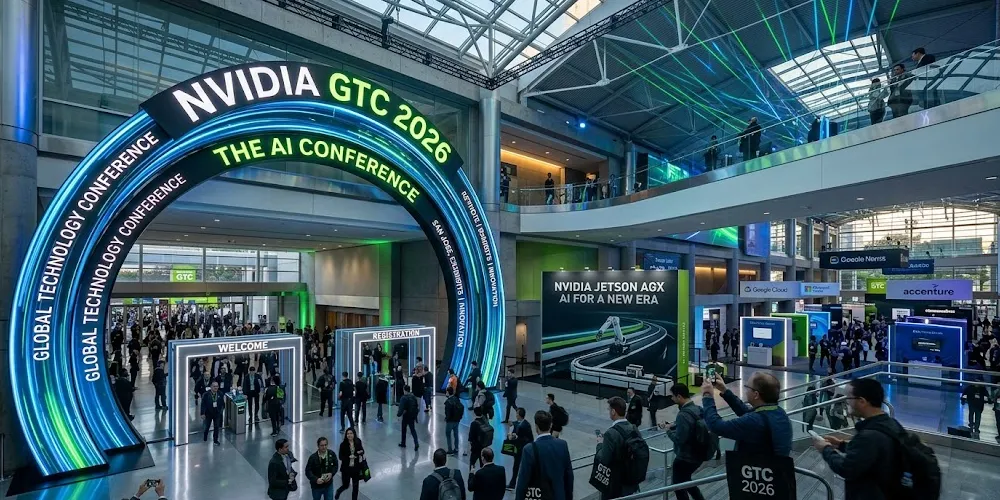
Nvidia CEO Jensen Huang opened GTC 2026 with a wide-ranging keynote outlining the company’s roadmap for the future of AI-driven computing. Held at the SAP Center in San Jose, the four-day conference is expected to attract over 30,000 attendees, reinforcing its status as a major global event for artificial intelligence and computing innovation.
During a keynote lasting more than two hours, Nvidia introduced new chips, computing systems, AI models, and software platforms, signaling a deeper push into full-stack AI infrastructure. The company also projected that its Blackwell and Vera Rubin chips could generate up to $1 trillion in sales by 2027.
Groq 3 LPU and LPX Rack for AI Inference
One of the headline announcements was the Groq 3 LPU (Language Processing Unit), an AI inference chip designed to enhance the performance of Nvidia GPUs. The chip builds on Nvidia’s partnership with Groq, following a major licensing agreement signed last year.
Alongside the chip, Nvidia introduced the Groq 3 LPX Rack, a high-density system capable of housing 256 LPUs. The rack is designed to significantly improve token processing efficiency, delivering up to 35 times higher tokens-per-watt performance when paired with Nvidia’s Rubin GPUs.
The system is optimized for large-scale AI workloads, including trillion-parameter models with extended context windows, and features liquid cooling built on Nvidia’s MGX infrastructure.
Vera CPUs: Next-Generation Processing Power
Nvidia also unveiled its new Vera CPUs, which are designed to replace the earlier Grace CPU architecture. These processors are expected to deliver 50% higher performance and double the efficiency compared to traditional rack-scale CPUs.
The Vera CPU rack includes 256 liquid-cooled processors capable of handling over 22,500 concurrent workloads. This makes it suitable for large-scale AI applications such as coding assistants, enterprise automation, and agent-based systems.
The CPUs are currently in production and are expected to be available in the second half of 2026 through major cloud providers including Alibaba, ByteDance, Cloudflare, and Oracle. Hardware partners such as ASUS, Cisco, Dell, Foxconn, and Lenovo are also expected to adopt the platform.
Vera Rubin Supercomputer Platform
The Groq 3 LPU and Vera CPU are part of Nvidia’s broader Vera Rubin supercomputer platform, which integrates seven advanced chips into a unified system. Other components include GPU racks, networking systems, storage infrastructure, and high-speed interconnects.
The platform is designed to support the full lifecycle of AI workloads, from training to deployment. Nvidia claims that Vera Rubin can deliver up to 10 times higher inference performance per watt and significantly lower cost per token compared to previous architectures.
It also enables developers to train large mixture-of-experts (MoE) models using fewer GPUs, improving efficiency and scalability for enterprise and research applications.
DLSS 5: Advancing AI-Powered Graphics
In addition to AI infrastructure, Nvidia introduced DLSS 5, the latest version of its AI-powered graphics rendering technology.
DLSS 5 uses neural rendering to generate photorealistic lighting and materials in real time, supporting gameplay at up to 4K resolution. The system processes motion and color data from game engines and enhances visuals using AI models trained on high-quality rendering data.
The technology is expected to launch later this year and will be supported by major game developers and publishers, including Ubisoft, CAPCOM, Tencent, and Warner Bros. Games.
Space-Based Computing: Vera Rubin Space-1
Nvidia also announced its entry into space-based computing with the Vera Rubin Space-1 platform. This system is designed for deployment in orbital data centers, supporting AI workloads in space environments.
The platform includes specialized modules engineered for constraints such as limited power, weight, and cooling. Nvidia is collaborating with companies like Axiom Space and Planet Labs to develop and deploy these systems.
While the concept represents a new frontier for computing, Nvidia acknowledged technical challenges such as radiation and thermal management in space.
NemoClaw: Safer AI Agent Deployment
To address concerns around autonomous AI systems, Nvidia introduced NemoClaw, a toolkit designed to improve the safety and reliability of AI agents.
The platform builds on OpenClaw, an open-source framework for creating autonomous agents capable of executing tasks independently. NemoClaw adds a layer of security by running agents in controlled virtual environments, reducing the risk of unintended actions or data exposure.
This development reflects growing industry attention on governance and safety in agentic AI systems.
New Nemotron AI Models
Nvidia expanded its Nemotron family of open-weight AI models with several new releases designed for agent-based applications.
- Nemotron 3 Ultra focuses on advanced reasoning, conversational capabilities, and visual understanding.
- Nemotron 3 Omni enables AI systems to extract insights from multimedia content such as videos and documents.
- Nemotron 3 VoiceChat supports voice-based interactions for AI agents.
The company also introduced Nemotron Personas, synthetic datasets designed to preserve privacy while enabling realistic AI training scenarios.
Some of these models are already available through platforms like GitHub and Hugging Face, as well as Nvidia’s own AI services.
GR00T N2: AI for Robotics
Nvidia previewed GR00T N2, a foundational AI model designed for robotics. The model aims to improve the ability of robots to perform tasks in unfamiliar environments.
According to Nvidia, GR00T N2 demonstrates higher success rates compared to existing vision-language-action models and is expected to become available by the end of 2026.
This announcement signals Nvidia’s continued expansion into robotics and embodied AI systems.
AI for Healthcare and Research: nvQSP
In the healthcare domain, Nvidia introduced nvQSP, a GPU-accelerated simulation engine for pharmaceutical research.
The platform enables scientists to simulate treatment scenarios and analyze multiple patient variables significantly faster than traditional methods. Nvidia claims nvQSP can deliver up to 77 times faster performance compared to standard CPU-based simulations.
This could accelerate drug development processes by allowing researchers to test hypotheses before clinical trials.
Outlook: Nvidia’s Expanding AI Ecosystem
The announcements at GTC 2026 highlight Nvidia’s strategy of building a comprehensive AI ecosystem spanning hardware, software, and applications.
From next-generation chips and supercomputers to AI models, graphics technologies, and space-based platforms, the company is positioning itself at the center of the AI infrastructure stack.
As demand for AI continues to grow across industries, Nvidia’s ability to deliver integrated solutions could play a key role in shaping the next phase of computing innovation.