


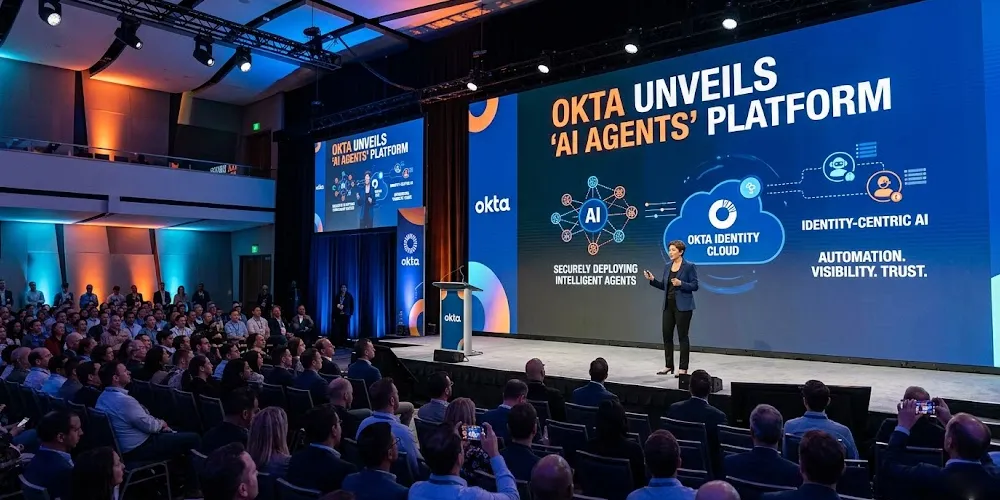
Okta has introduced a new platform designed to secure enterprise use of AI agents, as organizations face increasing security challenges linked to autonomous systems.
The new offering, called Okta for AI Agents, aims to help businesses monitor, manage, and control AI-driven processes as these systems become more integrated into enterprise operations.
Growing Security Concerns Around AI Agents
The launch comes at a time when AI agents are rapidly evolving and gaining autonomy across enterprise environments. These systems can execute tasks, access sensitive data, and make decisions with minimal human oversight.
According to Okta, 88% of organizations have already experienced suspected or confirmed security incidents involving AI agents. Despite this, only 22% of companies currently treat AI agents as distinct identities within their security frameworks.
This gap highlights the growing mismatch between traditional cybersecurity models and the new risks introduced by autonomous AI systems.
Identity-Centric Approach to AI Security
Okta’s platform is built around an identity-first model, treating AI agents as “first-class” non-human identities. The system is designed to answer three key questions for enterprises:
- Where AI agents are operating
- What systems they can access
- What actions they are allowed to perform
By applying identity and access management principles to AI agents, Okta aims to bring greater visibility and control to enterprise environments.
Discovery and Centralized Control
One of the core features of the platform is the ability to discover and register AI agents across an organization. This includes both approved systems and “shadow” agents that may have been deployed without IT oversight.
All identified agents are added to a centralized directory, enabling organizations to manage them more effectively and enforce consistent security policies.
The platform also integrates with a wide network of applications-over 8,000 in total-and supports popular AI platforms such as Boomi, DataRobot, and Google Vertex AI.
Access Management and Security Controls
To regulate interactions between AI agents and enterprise systems, Okta has introduced a centralized gateway. This gateway controls how agents connect to applications, APIs, and databases.
Additional security features include credential vaulting and access management tools that enforce least-privilege policies, ensuring agents only have access to the resources they need.
A notable capability is the “universal logout” feature, which acts as a kill switch. This allows organizations to immediately revoke an agent’s access across all systems if suspicious activity is detected.
Monitoring, Logging, and Integration
The platform also provides detailed logging and monitoring capabilities, enabling organizations to track AI agent behavior in real time. These insights can be integrated with existing security tools such as SIEM systems, helping enterprises strengthen their overall security posture.
This level of visibility is increasingly important as AI agents take on more complex roles within business workflows.
Availability and Industry Impact
Okta announced that the AI Agents platform will be generally available starting April 30, 2026.
The launch reflects a broader shift in enterprise cybersecurity strategies, as organizations move from experimental AI deployments to production-scale systems. As AI agents become more capable and autonomous, companies are seeking new frameworks to ensure they operate securely and responsibly.
By positioning AI agents as managed identities, Okta aims to address a critical gap in enterprise security and support safer adoption of AI-driven technologies.